
Do You Need Rental Restrooms at All?
Start with what the site already has. A venue with indoor restrooms sized for its capacity may need nothing, or one trailer for an outdoor ceremony that's far from the building. A backyard has the family's bathrooms, which were built for a household, not a guest list. A tented field, a farm or a garden with no building has nothing.
Ask the venue three questions: how many toilets and sinks are available to guests, how far they are from where the ceremony, cocktails and reception happen, and whether they're open the whole evening. A historic house with two bathrooms up a flight of stairs, a hundred yards from the tent, is the kind of answer that means you need rentals.
Trailer, Flushing Units or Both
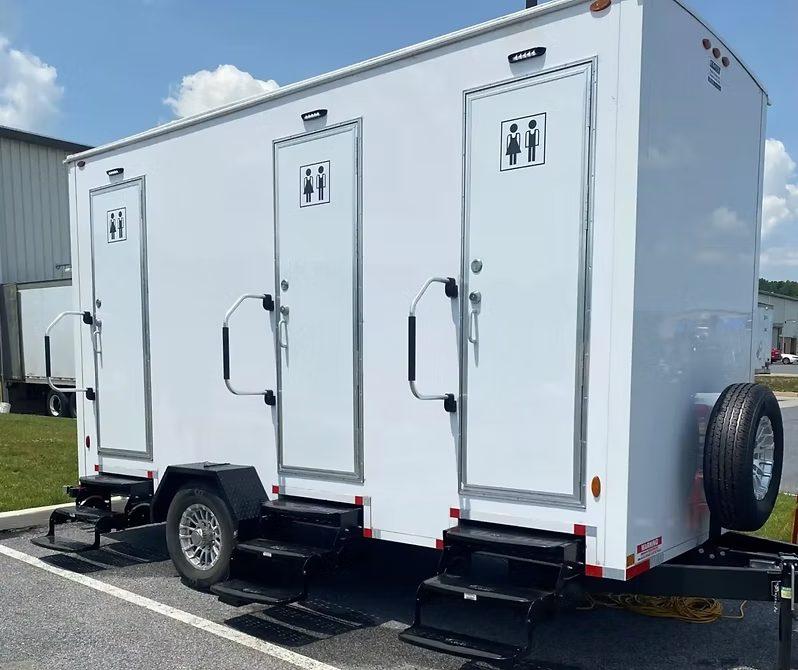
A luxury restroom trailer is a bathroom on wheels: real rooms with flushing toilets, vanity sinks with running water, mirrors, lighting and heat or air conditioning. It's the choice when the wedding has a dress code and the restrooms should match it. It needs power, a level spot and a way for a pickup to tow it in.
Flushing porta potties are single stalls with a fresh-water flush, no power and no hookup. They go where a trailer can't, like a rowhome back yard reached through a gate or a narrow side yard, and they cost less. With a sink inside each unit, or a hand wash station beside them, they read as planned.
Many weddings use both: the trailer near the reception for guests, a flushing unit or two at the ceremony site if it's a walk away, and a standard unit behind the catering tent for the staff and the band.
How Many Stations
There's no official formula for a wedding, so plan around the things that drive restroom use: the guest count, how many hours guests are on site, whether there's an open bar and when the rushes happen. Weddings have two: right after the ceremony and right after dinner and toasts. The women's side carries more of the load, so the stall count on that side matters more than the total.
A longer reception with a full bar sends guests to the restroom more often than a short afternoon luncheon. Give the guest count, the timeline and the bar plan when you ask for a quote, and the trailer size comes back matched to it. When it's close, go up a size; a line outside the restroom during the first dance is the thing guests remember.
- Guest count, including the wedding party and any vendors who'll use the guest restrooms
- Start and end times, from ceremony to last dance
- Bar service: none, beer and wine, or full open bar
- The rushes: after the ceremony and after dinner
- Separate staff restrooms behind the catering tent
Accessibility
A restroom trailer has steps, so on its own it isn't wheelchair accessible. A private wedding isn't held to the ADA's rule for public events, but a grandparent with a walker or a guest who uses a wheelchair still needs a restroom. An ADA-accessible unit beside the trailer, on level ground with a firm path to it, covers everyone.
For a wedding at a public venue or a park, the venue's own rules may require it. When portable restrooms serve the public, the ADA Standards call for at least 5% of each cluster to be accessible, with at least one per cluster.
Where the Trailer Goes
Pick the spot early, because it shapes the rest of the site plan. The trailer should be close enough to find in the dark, far enough from the dinner tables that nobody eats next to it, out of the background of the ceremony photos and downwind of the food. A lit path from the tent to the steps matters for an evening reception.
The ground has to be firm and close to level, and a pickup towing the trailer has to reach it: no low branches or wires, a gate wide enough and a lawn dry enough to hold the truck. On a property where the only spot is a soft lawn at the bottom of a slope, tell us before the quote is final.
- Firm, close to level ground: pavement, gravel or dry lawn
- A clear path for the truck and trailer, with no low branches or wires
- Power within reach of a heavy cord, or a generator
- Out of the photos, away from the tables, downwind of the food
- A lit walking path for guests after dark
Power, Water & the Weather
The trailer needs power for its lights, its water pump and its heat or air conditioning. A standard outdoor outlet within reach of a heavy cord works for many trailers; larger ones running air conditioning need more. Keep it off the circuit the band, the DJ or the caterer is using, because a tripped breaker in the middle of the reception takes out more than the music.
Water is on board in a fresh water tank that covers a one-day wedding. A July wedding in Philadelphia can sit near ninety degrees with heavy humidity, and the air conditioning is what keeps the trailer comfortable. For a late-fall or winter wedding, the heat keeps the guests comfortable and the water lines from freezing, so the trailer needs power the whole time it's on site.
Permits
A private wedding at a home doesn't need a city permit for its restrooms. A wedding in a city park, on a closed street or as part of a public event is different: portable toilets at a public event need the Department of Public Health's permit, an event in a park goes through Parks & Recreation, and a non-block-party event on a city street goes through the Streets Department's street event process, which limits those events to six hours. See the Portable Toilet & Holding Tank Permit Guide for the details.
A Booking Timeline
Spring and fall Saturdays are the busiest days of the year for restroom trailers, and the best way to get the size you want is to book when you book the tent.
- As soon as the date and venue are set: decide whether you need rentals and reserve the trailer
- Two to three months out: confirm the guest count, the layout and the spot for the trailer
- A month out: confirm power, the truck's path and any permits for a public venue
- The week of: confirm the delivery time and who'll meet the driver
- The day before: the trailer is delivered, leveled, connected and stocked
- The day after: pickup
Related Pages
Sources
- U.S. Access Board: Guide to the ADA Standards, Toilet Rooms (Portable Units, §213.2)
- City of Philadelphia: Apply for a Portable Toilet Permit (Department of Public Health)
- City of Philadelphia Streets Department: Street Event Application (non-block-party events, six hours maximum)
This guide explains the rules in plain language; it isn't legal advice. Permit requirements can change, so confirm with the city before the dumpster or the units go out.